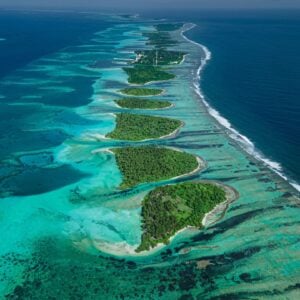

On March 14th, 2023, the Ministry of Tourism introduced a fresh regulation regarding boundaries of tourist establishments. This new Regulation replaces the earlier Boundary Regulation of 2012. While the new Regulation covers similar topics, they contain some additional and modified provisions. From now on, all matters related to boundaries are governed by this new Regulation.
The Regulation’s scope has been broadened to encompass tourist resorts, integrated tourist resorts, tourist hotels, resort hotels, and yacht marinas. The rules for determining the boundary outlined in the Regulation are applicable when the lease agreement does not specify the boundary of the island.
Demarcation of boundary
The boundary for an island that has been leased for developing a tourist resort will be measured from the dry land of that island during mean tide.
When the boundary of an island is defined in its lease agreement, that boundary will be considered as the official boundary for the island.
The general rule is to provide a boundary of 500 meters that is measured from the island’s dry land at mean tide. However, this rule applies only where the island has a lagoon area exceeding 500 meters, but will not be applicable if there is another island or sandbank within the same lagoon.
If an island’s boundary does not have 500 meters between its dry land and the outer reef, then its boundary will be the area from the dry land at mean tide up to its outer reef.
Boundary extension
If the lessee desires to expand the island’s boundary, they may do so by up to 1000 meters. However, the boundary cannot exceed the outer reef of the island, even with this extension.
For an island to be eligible for boundary extension, it must have a minimum of 500 meters of boundary from the mean tide to the outer reef. Any boundary extension will require payment of a fee of US$100,000 for every additional 500 meters, and the lease agreement must be amended to reflect the updated boundary.
If any rooms or related facilities have already been constructed with the approval from Ministry of Tourism’s authorization) but they lie outside the boundary defined by this Regulation, the boundary of the island will be expanded to incorporate a 50-meter radius from the footprint of those rooms and facilities.
Exemptions to boundary demarcation
Regardless of the previous statements, the boundary of an island designated for tourism development will be established as follows under the following circumstances:
- If the boundary of an island allocated for tourism development intersects with the territory of an inhabited island, the boundary of the tourism island will end where the territory of the inhabited island commences.
- If an island within a lagoon is allocated for tourism development and there is an uninhabited island or a tourist resort in that lagoon within a distance of less than 1000 meters from the designated island, then the boundary will be located at the midpoint between these two islands.
- Where the boundary of a tourism island needs to be determined according to these regulations, but there is another tourist resort located in the same lagoon with a specified boundary in its lease agreement, the boundary of the tourism island will be modified to begin where the boundary specified in the lease agreement of the existing tourist resort ends.
- Where the boundary of a tourism island established in accordance with these regulations overlaps with a boundary defined by another law, the boundary determined by this Regulation will be modified to commence from the endpoint of the boundary established by such law, unless the lease agreement specifies the island’s boundary.
Boundary adjustments
Even though an island has been reclaimed, its boundary will be determined based on the records of the Ministry of Tourism before reclamation. If such records are not available or unhelpful, the boundary will be established in accordance with these regulations after consultation with the Land Survey Authority.
All accretions to the island, whether occurring naturally or as a result of human activities, must be recorded with the Ministry of Tourism, which has discretion to determine whether to incorporate them into the resort’s land area. However, doing so may increase the land rent payable for the resort.
If buildings are to be constructed on an accretion of the island, it should be done so in accordance with the lease agreement and regulations pertaining to resort construction.
Exclusion of tourist attractions
If diving zones, surfing points, or tourist attractions fall within the island’s boundary, the boundary of the island will be modified to exclude those areas from within the boundary. The Ministry of Tourism shall publish a list of such places and enact regulations regarding their use.
A buffer zone of 50 meters, known as a “no development zone,” must be maintained inward from the island’s outer boundary. No tourism or development activities are permitted in this zone. If an accretion, island or a sandbank happens to occur naturally or otherwise, those places are not allowed to be leased for tourism purposes.
Marking out special zones
The Regulation marks out special zones exclusive to the resorts. Where the boundary of a tourist resort is determined to be up to the outer reef, an additional 300 meter radius from the outer reef will be considered as an “exclusive zone” belonging to the resort. The exclusive zone can only be developed with special permission from the Ministry of Tourism either for the purpose of developing renewable energy or for an important environmental project.
Where an exclusive zone overlaps with an inhabited island or an area demarcated for another purpose under another law, the exclusive zone will be up to the outer boundary of the overlapping area.
Boundary area of lagoons
The Regulation requires the boundary area of lagoons leased for tourism purposes to be specified in the lease agreement. Those Lease agreements under which the boundary of lagoons have not been specified at the time of this Regulation, parties are required to bring an amendment specifying the boundary.
Determining boundary under new lease agreements
For new lease agreements executed after the commencement of this Regulation, the boundary of the surrounding lagoon is required to be specified in the lease agreement within 1 year of the date of leasing.